Martin’s visit to the “real dirt” and the philosophy debate
Martin EdenMartin Eden's visit to Kreis's lodgings and the ensuing philosophy debate mark a turning point in his experience of intellectual life. In a crowded labor district, he encounters people whose arguments range across philosophy, politics, literature, and labor organizing. The disputation between Kreis and Norton makes idealism newly intelligible to him, while his response preserves rather than resolves his allegiance to realism and Herbert Spencer. He leaves for Oakland intellectually stirred, conscious both of what he has learned and of how much more he wants to know.
The Gathering at Kreis's Lodgings
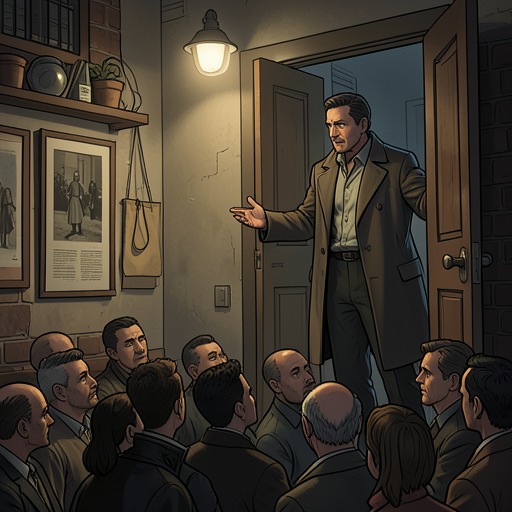
Brissenden leads Martin through the darkness to a door marked by a narrow thread of light. Inside, Martin meets Kreis, a strikingly presented host, and sees the cramped arrangement of the rooms: the small back room serves as kitchen and dining room, while the front room is both bedroom and living room. Washing hangs overhead in festoons, initially obscuring two men talking in a corner. Those men are Andy and Parry, whom Martin joins as they discuss a prize-fight Parry has seen. Brissenden, meanwhile, makes a toddy and serves drinks; at his direction, Andy goes to summon the other lodgers.
The gathering is not defined by a single occupation or political position. Parry is an Australian statistician and sporting encyclopaedia, able to retrieve exact facts about grain production, imports, and boxing; Andy is a stone-mason with opinions on many subjects and a talent for chess. Hamilton, Martin learns, organized the Cooks' and Waiters' strike after planning it in Kreis's rooms, but did not remain with the union. His ability and his reluctance to sustain an organized role coexist. The room thus brings practical knowledge, political action, and intellectual argument into the same social space.
A Working-Class Forum
Once the conversation gathers momentum, Martin notices that these lodgers have opinions of their own and connect subjects rather than treating them as isolated scraps of information. Their discussion moves from a new novel and a recent play to the future of drama, then to labor conditions in New Zealand, literature, German politics, and local union-party disputes. They know the concealed maneuvers behind labor struggles as well as the public accounts printed in newspapers. Their knowledge has been acquired and tested in a world of political organization and work, not merely borrowed from books.
Mary, who has been washing dishes in the back room, joins the discussion. She talks with Martin about Swinburne and Rossetti, then takes him into areas of French literature beyond his knowledge. Her presence enlarges his sense of who participates in serious intellectual exchange. The conversation he experiences at the Morses' had not prepared him for this range of discussion or for the ease with which subjects and speakers cross customary boundaries. The lodging house's tight domestic quarters become a forum where people whose lives are shaped by work and poverty argue over culture, politics, and ideas.
The Dispute over Philosophy
Brissenden presents Martin to Kreis as an ardent admirer of Herbert Spencer and invites Kreis to turn him toward Haeckel. Kreis begins to question him, but Norton intervenes, and the exchange shifts into a contest between Norton and Kreis. Hamilton joins Kreis's side of the dispute. Martin, who has previously found idealism unattractive, listens as the disagreement turns on how knowledge can justify claims about reality. Norton challenges the assumption that positive science can move beyond appearances to establish what matter is in itself or to settle questions about ultimate reality. The argument also touches on Berkeley, Kant, and Spencer, while the participants dispute whether reasoning should proceed from facts or whether it relies on words that only seem to explain them.
The debate matters to Martin not because it converts him, but because it makes philosophy vivid and disputable. The ideas are no longer remote doctrines attached to famous authors: the speakers argue them with excitement, and others follow closely, cigarettes going out in their hands. Kreis and Hamilton treat Norton as a metaphysician; Norton counters that they too make philosophical assumptions when they claim to reason from facts. Martin sees that people in this room can challenge one another's premises rather than repeat received opinions. The scene also complicates his attachment to Spencer: Norton is not a Spencerian, and the debate gives Martin reason to test his confidence without simply surrendering it.
Martin's Response and Departure
The gathering ends for Martin and Brissenden because they must catch the last ferry to Oakland. Norton remains in the room, still speaking, while Kreis and Hamilton wait to answer him. The unfinished discussion gives the scene an open ending: Martin departs before the argument is settled, and its continuation belongs to his future reading and thought rather than to a verdict delivered that night.
On the ferry, Martin tells Brissenden that meeting such people makes life worthwhile. He says the discussion has worked up his mind and that he had never before appreciated idealism, although he still cannot accept it and expects to remain a realist. He believes Spencer has not been refuted, yet wishes he had answered Kreis and Hamilton and also had something to say to Norton. He resolves to read more, seek out Saleeby, and take part in the next discussion. Brissenden, breathing painfully, falls asleep with his chin in a scarf against his sunken chest, wrapped in a long overcoat and shaken by the ferry's vibration. Martin's eager intellectual afterglow and Brissenden's exhausted silence form a quiet contrast at the close: one carries the debate forward in thought, while the other sleeps through the crossing.